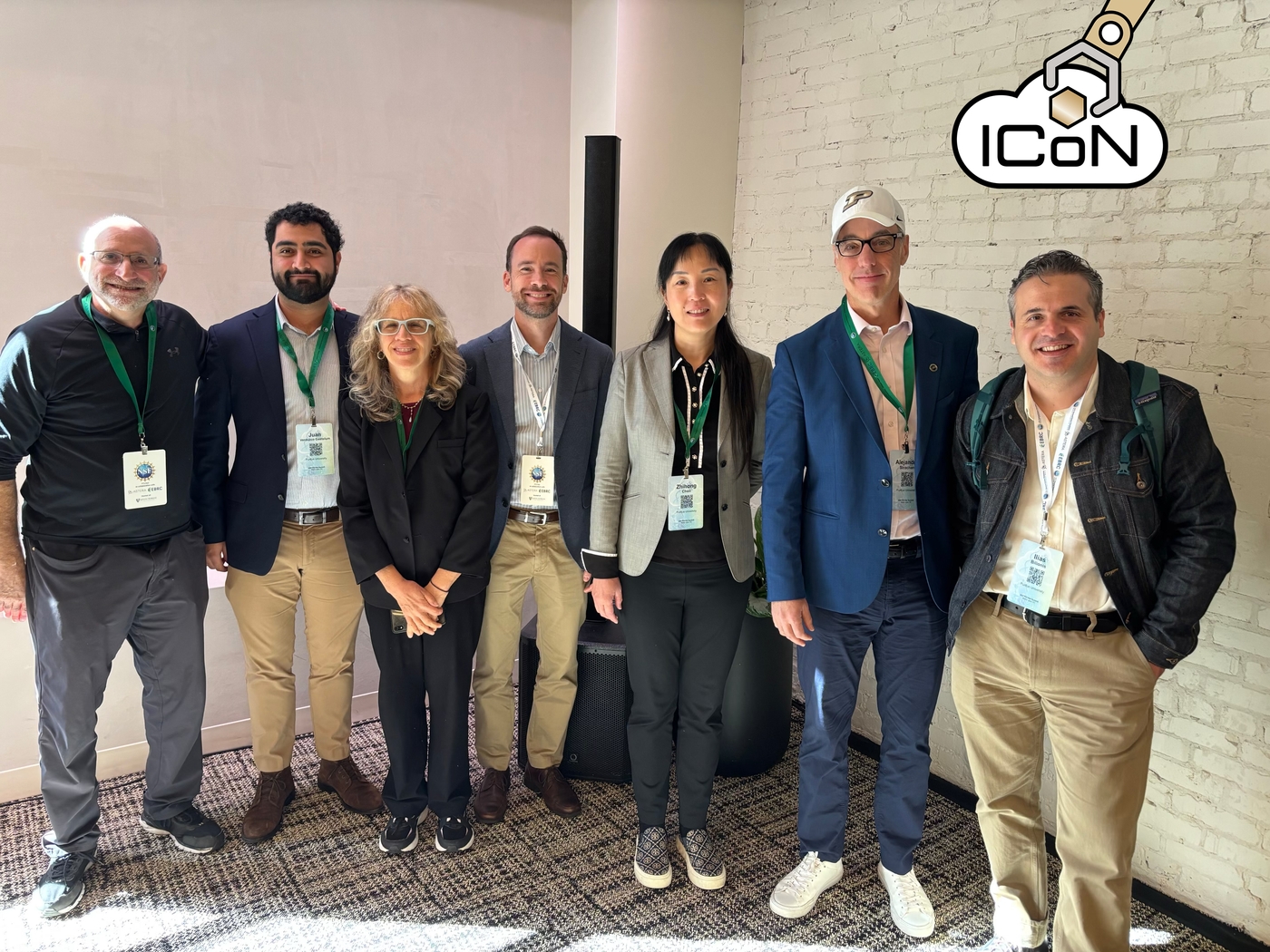
Photo: Dr. India Hook-Barnard
The ICoN-PCL team traveled to Washington DC on September 24–25 for the kickoff summit of the National Science Foundation’s Programmable Cloud Laboratories network, the first time the twenty funded test beds were together in one place. NSF’s PCLNET hosted the meeting with the Astera Institute and the Engineering Biology Research Consortium, across two days at the Johns Hopkins University Bloomberg Center and Convene Hamilton Square.
Prof. Alejandro Strachan was joined by Juan Carlos Verduzco, the test bed’s technical director and a member of our group; co-PIs Ilias Bilionis and Juan Wachs, leading the AI and robotics efforts; Zhihong Chen, director of the Birck Nanotechnology Center, and Michael Titus, who together lead characterization and testing; Tianyi Zhang, on data and AI; and Jane Greenberg of Drexel University’s Metadata Research Center, the project’s data lead.
The first day was given to introducing all twenty nodes, with panels on relevance and on global perspectives. It was a first look at what the other nineteen teams are building across seven scientific domains, from engineering biology to semiconductors.
The second day moved into working sessions, where the teams took up the questions that will shape what a national network of programmable laboratories becomes.
One is scope. A facility built to serve every user and every experiment requires infrastructure that grows faster than any single project can deliver, which makes defining what a test bed will and will not do as consequential as the science it enables.
Another is expertise. Programmable laboratories ask AI researchers, domain scientists, and facility staff to work fluently across fields that rarely share a vocabulary. Building that fluency is a long-term commitment rather than a hiring decision.
The third is trust. As experiments are increasingly planned, executed, and interpreted with automation, the network will have to establish what counts as evidence, and how researchers come to rely on results they did not produce by hand. It is a question the scientific community has not had to answer in this form before.
The summit turned twenty separate awards into a network with common footing. For ICoN-PCL, it will shape how the test bed takes form at Purdue over the next four years.
To follow the project, its facilities, and its team, visit the ICoN-PCL website. The award itself is covered in our earlier highlight.