Research Interests
Materials at Extreme Conditions
We study how materials respond to shock waves, extreme pressures, and rapid thermal loading relevant to energetic materials, propulsion, and planetary science. Our simulations span multiple scales: machine-learned interatomic potentials capture reactive chemistry at near-DFT accuracy, while coarse-grain models extend accessible length and time scales to the micron level.
Key questions we address include how shock waves propagate and dissipate energy through plasticity in molecular crystals, how microstructural features such as interfaces and pores nucleate hot spots that govern initiation sensitivity, and how composite formulations behave under ultrafast thermal loading. Our simulations reveal atomic-scale mechanisms that are inaccessible to experiments and inform continuum models.
Neural network reactive force field for CHNO energetic materials, J. Chem. Phys. (2023) ↗
GNN coarse-grain force field for the molecular crystal RDX, npj Computational Materials (2024) ↗
Steady-state elastic-plastic shock waves in a molecular crystal, Physical Review B (2025) ↗
Melting dynamics at microstructural defects in TNT-HMX composites, J. Phys. Chem. C (2025) ↗
Materials Discovery & Active Learning
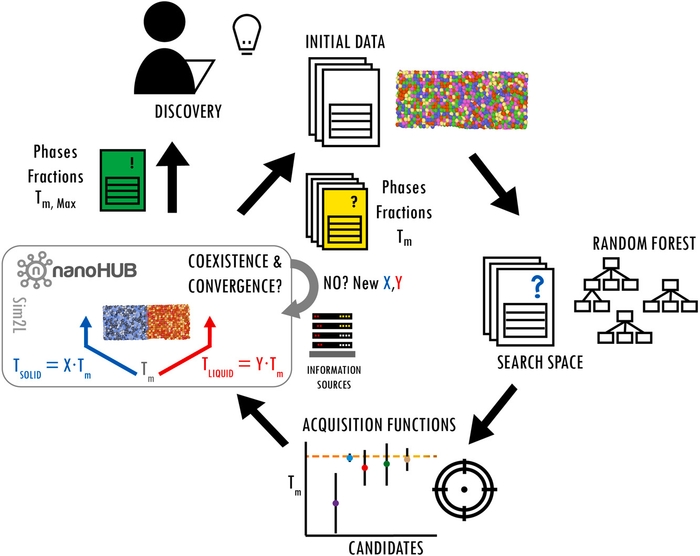
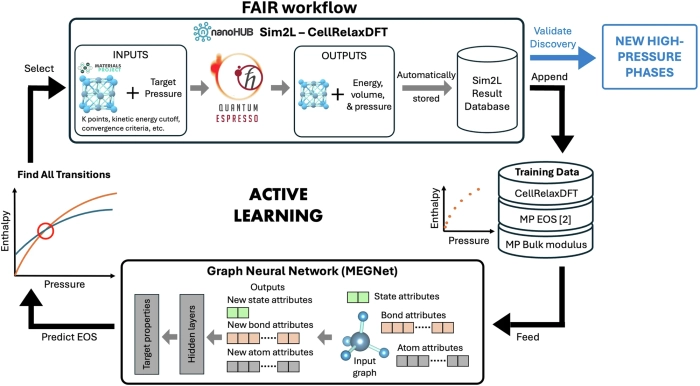
The compositional spaces of modern materials (multi-element alloys, 2D materials, high-pressure phases) are far too large to explore exhaustively. We develop and apply active learning strategies that combine physics-based simulation, machine learning, and experiment to navigate these spaces efficiently, identifying high-performing candidates with a fraction of the evaluations required by traditional approaches.
In metallic alloys, active learning guided by atomistic simulations and ML models has led to the discovery of record-hardness complex concentrated alloys and oxidation-resistant refractory compositions for extreme temperatures. For 2D materials, high-throughput DFT screening of thousands of MAX phase precursors (the bulk parents of MXenes) provides an open, queryable map of energetics and stability to guide synthesis of new MXene compositions.
Discovery of high-hardness complex concentrated alloys, J. Applied Physics (2025) ↗
High-throughput DFT screening of MXene precursors, Scientific Data (2023) ↗
Polymers & Composites
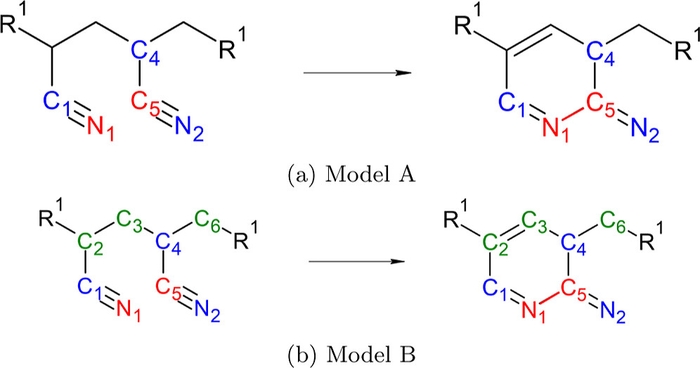
We use molecular dynamics to study polymers and composites from processing through performance. This includes simulating reactive chemistry (curing of thermosets, stabilization of carbon fiber precursors, and processing of energetic binders) to build realistic crosslinked molecular structures, which are then used to predict mechanical, thermal, and transport properties.
A core challenge is modeling condensed-phase reactions accurately: which bonds form, in what sequence, and at what rate all depend on the local molecular environment in ways that simple geometric criteria miss. We develop machine learning models trained on large MD datasets to capture these dependencies, improving the fidelity of simulated polymer structures and the properties predicted from them.
Molecular modeling of PAN stabilization during carbon fiber processing, Macromolecules (2024) ↗
ML models for reaction rates in condensed-phase polymer processing, Macromolecules (2026) ↗
FAIR Data & Scientific Infrastructure
We develop Sim2L, a workflow framework on nanoHUB that automatically captures all inputs, outputs, and provenance of simulation runs, making results Findable, Accessible, Interoperable, and Reusable (FAIR). Paired with queryable ResultsDB databases, data from published campaigns become a live resource for subsequent machine learning studies rather than a static supplement buried in a journal appendix.
The impact is concrete: by reusing a FAIR database of prior alloy melting temperature simulations on nanoHUB, active learning required only 1 simulation per composition versus ~4.4 without prior data, a 10x effective speedup. Current open databases include the MAX-phase DFT database of 8,712 MXene precursors, the RefOxDB oxidation database, and the UnderPressure high-pressure phase database. As Co-Director of nanoHUB and ChipsHub, Prof. Strachan also leads broader cyberinfrastructure for open science and semiconductor design education.
Accelerating active learning with FAIR data and workflows, Computational Materials Science (2025) ↗
Community action on FAIR data will fuel a revolution in materials research, MRS Bulletin (2024) ↗
RefOxDB: mass uptake during oxidation of metallic alloys, Computational Materials Science (2024) ↗