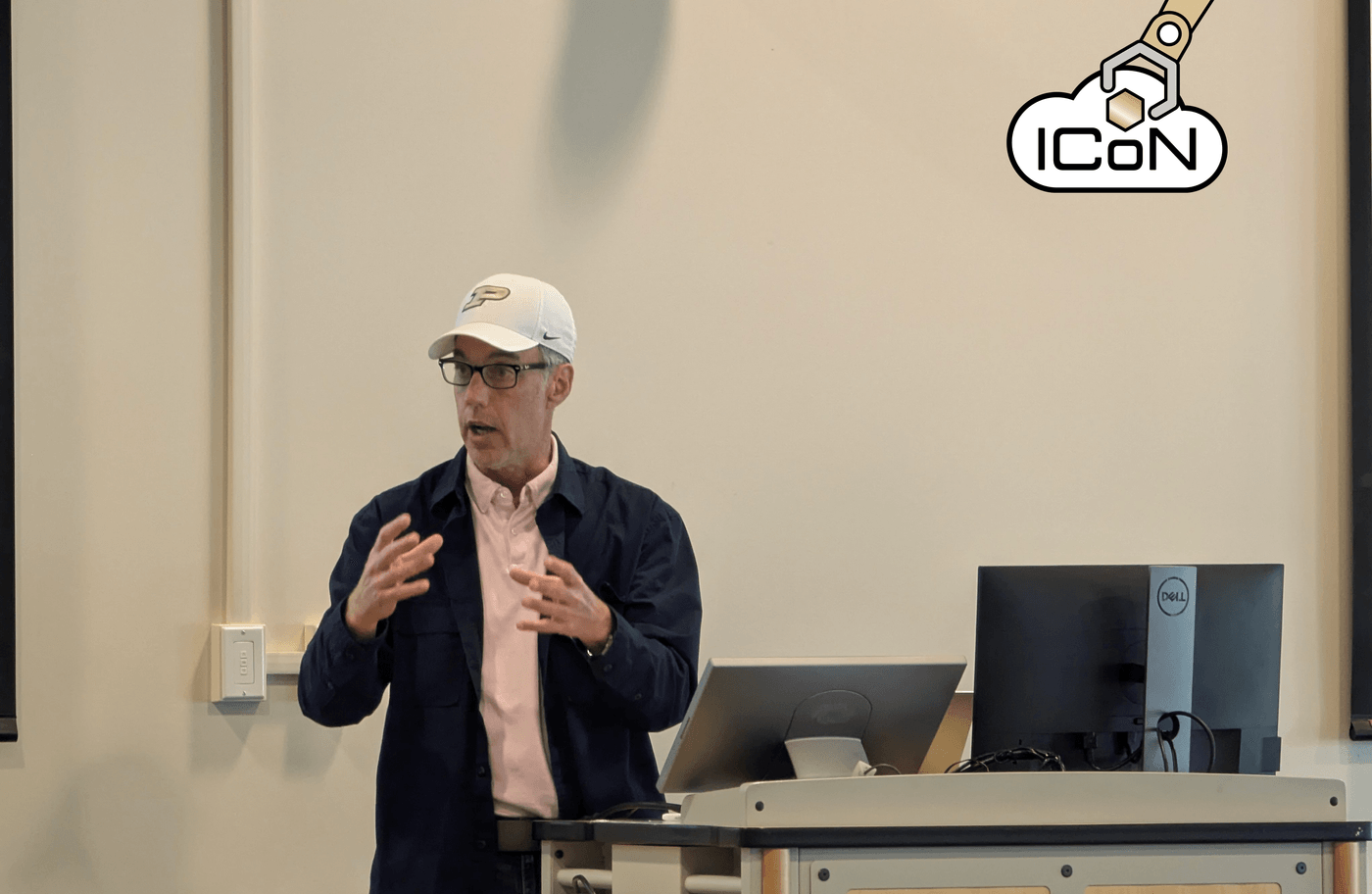
Photo: Juan C. Verduzco
Prof. Alejandro Strachan will direct a new $19 million NSF test bed, the Intelligent Codesign Cloud Lab for Non-Equilibrium and Low-Dimensional Materials (ICoN-PCL) — an online platform that gives researchers remote access to physical labs, simulations, and AI tools for designing advanced materials and the processes used to manufacture them.
The project brings together Purdue’s Birck Nanotechnology Center and Manufacturing and Materials Research Laboratories (MMRL) with Drexel University’s Metadata Research Center. It’s funded through the National Science Foundation’s Test Bed: Toward a Network of Programmable Cloud Laboratories program, and will focus on two of the group’s core interests: next-generation 2D materials for electronics, and materials engineered to survive extreme conditions in energy and aerospace systems.
For our group, ICoN-PCL builds on years of experience with nanoHUB, which provides the platform’s simulation-access layer — FAIR, queryable infrastructure that other researchers can already use today. What ICoN-PCL adds is new: access to physical lab equipment, multiagent AI assistants, digital twins, and automated experimentation workflows, so materials discovery, manufacturing, and device fabrication stop operating as disconnected steps.
Prof. Strachan on why this matters:
“For decades, materials discovery, manufacturing and device fabrication have operated in silos, slowing the path from breakthrough to real-world impact. ICoN-PCL is about bringing these pieces together by using AI and data to enable true codesign, where materials and processes are developed simultaneously to accelerate innovation in ways we simply couldn’t accomplish before.”
ICoN-PCL is one of 20 test beds funded nationwide through this program — a four-year, $400 million investment combining $380 million from NSF with $20 million in philanthropic matching from the Astera Institute.
NSF Assistant Director Erwin Gianchandani on the broader vision:
“The NSF Programmable Cloud Laboratories initiative will unlock new discoveries in a wide range of fields and while also advancing AI-enabled technologies that form the backbone of the automated science revolution. These awards represent a significant step toward achieving a virtuous cycle of automated hypothesis generation, autonomous experimentation and generation and interpretation of large volumes of high-quality experimental data to drive the next set of hypotheses, all with researchers and students alongside the automated systems at every step of the way.”
To follow the project, its facilities, and its team, visit the ICoN-PCL website. For the full announcement, funding details, and partner institutions, see Purdue’s official coverage and NSF’s program announcement.