Materials at Extreme Conditions
Neural network potentials and GNN coarse-grain models to predict shock response, hotspot formation, and detonation in energetic materials.
Learn more →School of Materials Engineering · Purdue University
We develop and apply predictive atomistic and molecular simulations to understand and design materials, from energetic materials and metals to polymers and beyond.
Predictive, physics-based understanding of materials that enables rational design, from the atomic scale to engineering applications.
We develop atomistic and molecular simulation methods, machine learning models, and open data infrastructure to understand and design materials for energy, defense, and sustainability, bridging quantum mechanics, statistical mechanics, and data science.
Neural network potentials and GNN coarse-grain models to predict shock response, hotspot formation, and detonation in energetic materials.
Learn more →Active learning and high-throughput DFT to discover high-performance alloys and map the compositional landscape of 2D MXene precursors.
Learn more →Reactive MD of condensed-phase chemistry — from carbon fiber stabilization to thermoset curing — coupled with GNN models for reaction rates.
Learn more →Sim2L workflows and queryable nanoHUB databases making simulation data reusable — 10× faster active learning.
Learn more →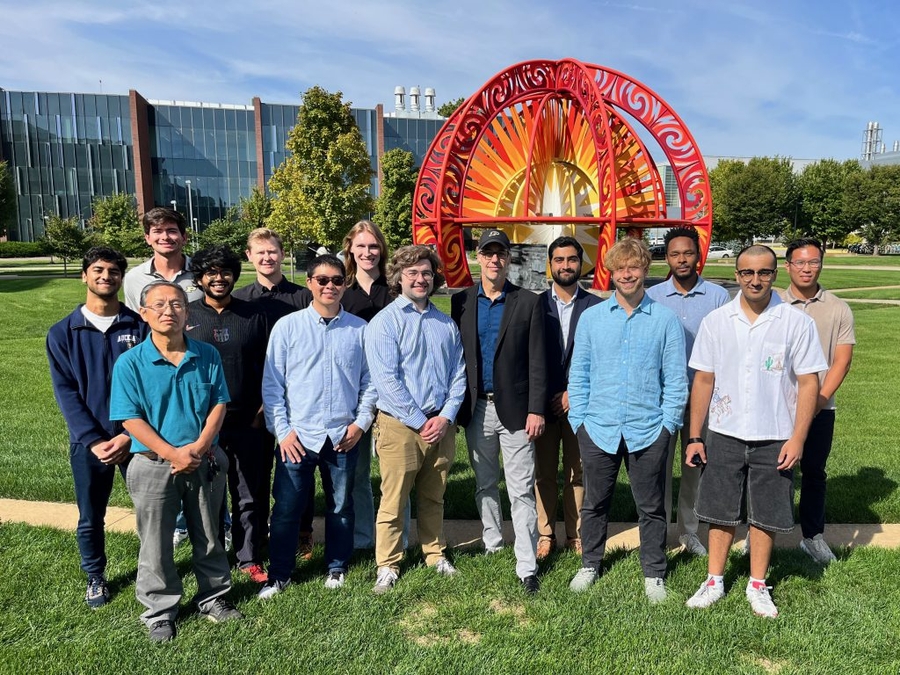
The Strachan Group is a team of graduate students, postdoctoral researchers, and undergraduate students at Purdue's School of Materials Engineering. We are united by a passion for understanding materials through computation and simulation.
Meet the team → About Ale Strachan →The shock-to-detonation transition in energetic materials is governed by coupled processes at extreme temperatures, pressures, and strain rates spanning Ångstroms to millimeters and femtoseconds to microseconds. Traditional multiscale models fail due to the lack of equilibrium and scale separation across the phenomena involved. We address this grand challenge by directly bridging large-scale molecular dynamics (MD) simulations with continuum finite-element (FE) models using MISTnetX, a convolutional deep neural network. Trained on MD simulations of shock propagation through complex microstructures, MISTnetX captures shock–microstructure interactions, hotspot formation, and the transition to deflagration, supplying critical sub-grid information to FE simulations of mechanics, shocks, thermal transport, and chemistry. Applied to a synthetic but realistic nanostructured plastic-bonded RDX composite, MISTnetX enables parameter-free prediction of the full run-to-detonation transition.
Nuclear quantum effects (NQEs) are often central to a predictive understanding of chemical reactions and rates. While their incorporation in gas-phase reactions is well established, studies involving condensed matter often neglect or approximate such effects. To clarify the role of NQEs in multistep, multimolecular reactions in a molecular crystal, we compare atomistic simulations of the thermal decomposition of the energetic material TATB using the path integral-based thermostatted ring polymer molecular dynamics (TRPMD), the more approximate quantum thermal bath (QTB), and classical MD (ClMD). TRPMD samples the quantum canonical distribution by representing each atom as a string of beads (replicas), while QTB uses a frequency-dependent thermostat to reproduce the Bose–Einstein distribution. We find that TRPMD results in faster chemical decomposition of the TATB crystal compared to ClMD, as the initial steps involve hydrogen transfer processes. Interestingly, some of the subsequent reactions (e.g., the formation of N2) occur on identical time scales. The TRPMD simulations also predict a reduction in overall activation energy by ∼8% as compared to the classical result. As observed in model systems and simple unimolecular gas-phase reactions, the QTB significantly overestimates quantum acceleration of chemical reactions and the reduction in activation energy. A comparison of the kinetic energy operator in TRPMD and the centroid dynamics provides insight into the physics behind the differences between the QTB and TRPMD results.
Refractory complex concentrated alloys (RCCAs) are of significant interest for advanced high-temperature applications, but their compositional complexity challenges conventional discovery approaches. In this study, an active learning framework is introduced that integrates Gaussian process regression with Bayesian global optimization to accelerate the identification of oxidation-resistant RCCAs. Focusing on aluminum-containing quaternary systems, alloy and oxide descriptors were utilized to predict oxidation performance at 1000 °C. Beginning with a dataset of 81 experimentally validated alloys, the framework iteratively selected five-alloy batches, balancing exploration and exploitation to minimize experimental costs. After six iterations, two alloys (nominal Al30Mo5Ti15Cr50 and Al40Mo5Ti30Cr25) were identified that exhibited specific mass gains < 1 mg/cm2 for 24 h at 1000 °C in air. Both alloys formed adherent external α-Al2O3 scales and exhibited two-stage oxidation kinetics that decelerated into a slow-growing, diffusion-limited protective regime, consistent with the dense, adherent α-Al2O3 scale confirmed by transmission electron microscopy. Furthermore, multiobjective analysis indicates that these alloys achieve high predicted specific hardness (> 0.12 HV0.5 m3/kg) and predicted thermal expansion characteristics relevant to high-temperature coating applications, warranting further investigation. This work underscores the efficacy of active learning in traversing complex compositional landscapes to develop advanced materials for extreme environments.
Large language models (LLMs) are changing the way researchers interact with code and data in scientific computing. While their ability to generate general-purpose code is well established, their effectiveness in producing scientifically valid scripts for domain-specific language (DSLs) remains largely unexplored. We propose an evaluation procedure that enables domain experts to assess the validity of LLM-generated input files for LAMMPS, a widely used molecular dynamics (MD) code, without requiring deep familiarity with its syntax. The evaluation procedure combines a normalization step that produces canonical input files with an extensible parser for syntax analysis, followed by a reduced-cost execution stage and accuracy checks that isolate common errors before running costly simulations. We apply the pipeline to eight state-of-the-art LLMs across three prompts of increasing complexity. The parser pass rate has improved from 74% to 91% over the past year, but scientific accuracy on coupled multi-step workflows remains limited. Across all 80 scripts evaluated on the most complex prompt, only one was fully correct as generated. We further package the automated stages as a reusable agentic skill that LLMs can invoke during script generation; in a small-scale demonstration, this skill helped two models produce five fully correct scripts out of six across the same three prompts, including the hardest one. The pipeline highlights both the limitations of current LLMs in generating scientific DSLs and a practical path toward integrating them into domain-specific computational ecosystems.